


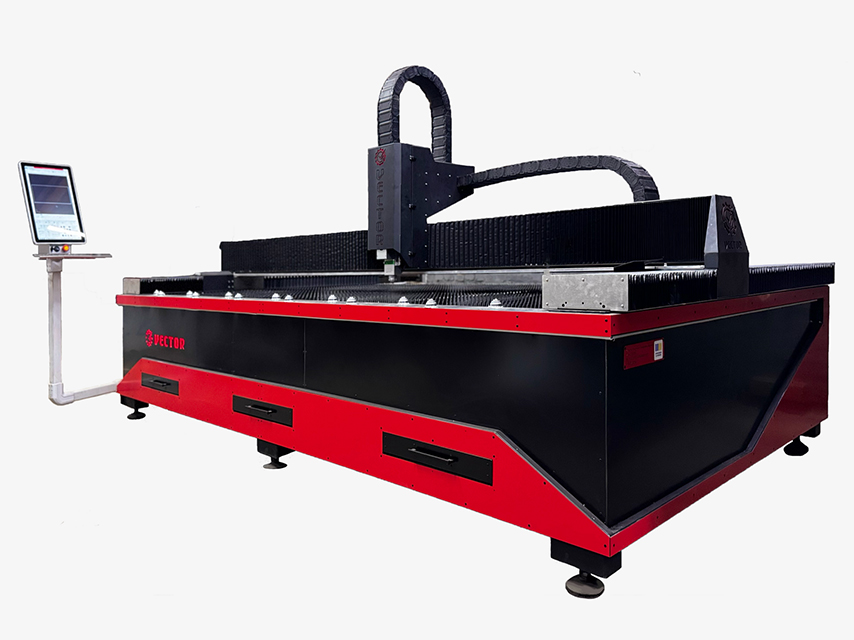


Vector 3015OVL Fiber Laser Cutting Machine for Sheet Metal
49 500 €
Materials
Steel • Aluminum • Brass • Copper
Technical specifications
| Main Working Travel Y, X, Z, mm | 3000x1500x150 |
|---|---|
| Design | Moving Gantry |
| Bed | All-steel welded, milled in one pass |
| Dimensions (LxWxH), mm | 3600х2100х1700 |
| Laser type | Fiber |
| Laser source | Maxphotonics Elite (back-reflection protection) |
| Power, kW | 3 |
| Cutting head | Raytools (Switzerland) |
| Cooling | S&A CWFL-30 chiller |
| Max. traverse speed, m/min | up to 100 |
| Guides | Rectangular Profile |
| Feed Mechanisms | Helical Rack X, Y axes / Ball Screw Z axis |
| Drives | Servo Motors and Planetary Gearbox |
| Repeat Positioning Accuracy, mm | up to ±0.05 mm |
| NPN Limit Sensor | Inductive Type |
| Control System | FSCUT |
| Mains Voltage Sensor | Informs CNC Operator |
| Remote Control Panel | + |
| Laser Head Autofocus | + |
| Laser Source Back-Reflection Protection System | + |
| Material Standoff Distance Sensor | + |
| Low Assist Gas Pressure Sensor | + |
| Emergency Stop Button | + |
| Flow Sensor | + |
| Semi-Automatic Lubrication System | + |
| Control Cabinet with Controller | + |
Fiber laser is a technology that fundamentally changes the economics of metal fabrication. Unlike plasma, which produces a wide kerf, requires secondary edge finishing, and consumes significant power, fiber laser cuts faster, more precisely, and with minimal operating costs. And unlike CO₂ lasers, it handles reflective metals: copper, brass, polished aluminum, — without the risk of damaging the source.
The Vector 3015OVL is an industrial solution built around this technology. The 3000×1500 mm working area matches standard sheet formats, enabling full material utilization. The all-steel welded bed, milled in a single pass, eliminates cumulative assembly errors — ensuring stable geometry regardless of the cutting position across the work area.
Key Advantages of the Vector 3015OVL:
- Speed and precision that transform shop floor productivity. Fiber lasers operate at ~1 µm wavelength, which is efficiently absorbed by metals. This enables cutting thin and medium sheets several times faster than plasma or CO₂. The result — more parts per shift with the same energy input.
- Edge quality that eliminates secondary finishing. Fiber laser precision delivers a narrow kerf and clean edge. Parts go to welding or assembly without additional grinding or deburring. This shortens the production cycle and reduces reliance on manual operations.
- Consistent power output without operator intervention. The Maxphotonics Elite laser source with built-in back-reflection protection maintains rated power throughout its service life. Cutting speed and quality remain stable over time — you get predictable results without recalibration.
- Processing non-ferrous metals without limitations. CO₂ lasers struggle with copper, brass, and polished aluminum — they reflect the beam and can damage the source. Fiber lasers cut these materials as effectively as mild steel. For manufacturers working with multiple metals, this means one machine instead of two.
- Lower operating costs. Fiber technology consumes significantly less energy than CO₂ lasers, while the absence of consumable mirrors and gas mixtures further reduces operating expenses.
The base configuration includes an S&A CWFL-30 chiller, FSCUT control system, remote pendant, full safety sensor suite, and semi-automatic lubrication. Additional options are available to expand capabilities. The machine price depends on selected options, allowing budget optimization for your actual production needs.
Applications:
- Metal structures, frame components, and supports.
- Enclosures for electronics and mechanical engineering.
- Parts for metal furniture and kitchen equipment.
- Ventilation systems and air ducts.
- Signage and 3D metal letters.